

Guild Wars 2 Diary #9 : A World To Explore
This week, we take a break from carrying on with the story but instead we'll take a look at the World we have been exploring in the past eight weeks. I have been thinking about the game, mostly about how little I’ve got through the damn thing. We’re fairly rapidly coming up to 10 weeks of Guild Wars 2 diaries, and I don’t think I’ve seen even 5% of the game. That says an awful lot about the fantastic effort that has been put into the different areas, different races, different towns and villages.
Tyria
Tyria is the world that you’ll explore during Guild Wars 2, and it’s also the name of the continent as well. The world boasts several different areas, as you’d expect. Some of these areas are coated in forests and thick woods, others snowy mountains. There’s a huge amount to see, a huge amount to do and a bevy of dangerous monsters to fight and kill.
Guild Wars 2 Gameplay Video - Episode #9
At least 250 years separates the original Guild Wars with its sequel and the world of Tyria has changed a lot since. Comparing the two maps shows how much the land has changed, how many races and peoples have moved on and the effects of events in the original game. Although you don’t need to have played Guild Wars to enjoy Guild Wars 2, there are a ton of references and, of course, seeing familiar locations – even massively changed – is nice.
Queensdale
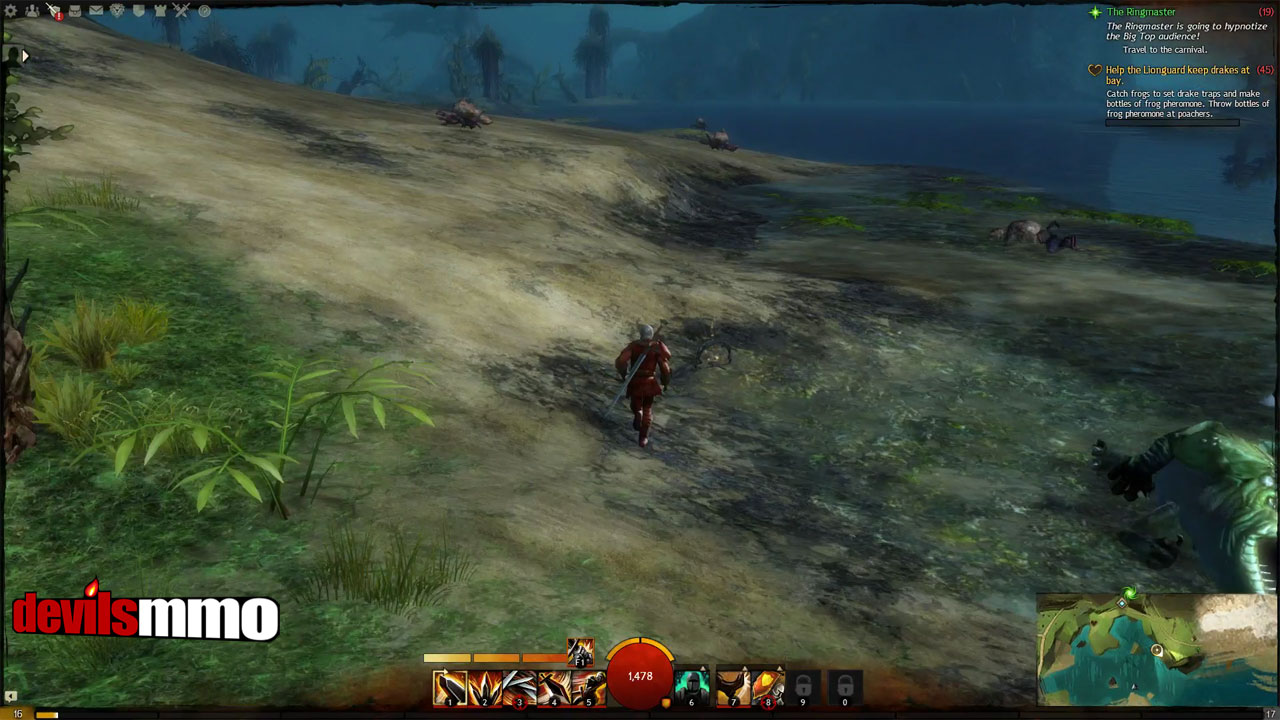
We’ve been to Queensdale a lot in previous weeks – we started the story nearby and much of what we’ve seen has been within a short distance of, if not, within this area. It’s made up of several small villages and farm towns, as well the massive Divinity’s Reach. Queensdale reminds me a little bit of The Shire in Lord of the Rings – some minor hills and mountains, homesteads, minor danger.
Divinity’s Reach is a pretty fantastic city, both in terms of scale and in terms of construction. Chalk and cheese is an apt cliché when comparing Divinity’s Reach and the outlying area – it’s a metropolis of industry, artisans, shops and excitement, whereas other areas are calmer, quieter and easier to explore. There are other cities in the world of Guild Wars 2, but this will be the first you see if you’re human and, honestly, you won’t see a more impressive sight if you enjoy urban scenes.
In terms of the place Divinity’s Reach actually holds in the world, it is the hub for humankind, a mismatch of races and peoples with nowhere else to go. It takes a long while to explore, but the developers have also made an effort to make it look like it’s bigger than it is explorable. Towers and homes stretch out into the distance, showing a city that is not only fully populated, but growing as well.

Lion’s Arch
Where Divinity’s Reach is the home of humankind, Lion’s Arch is built up of every race you can think of. The two cities aren’t a massive distance apart, and performing renown heart and story quests will probably bring you here sooner rather than later. You’ll also end up here if you go into the PvP games. Like Divinity’s Reach, this is a pretty big place, but it feels slightly more open than the human city. The walls outside seem like the remains of some ancient pirate ship, a sign of how this city came about.
It was the human capital once, until flooding destroyed it. Once the waters subsided, mercenaries, pirates and fighters took over, rebuilding it with the ships and nautical equipment they no longer needed. If it seems a little more haphazard than Destiny’s Reach, it’s because it is.
Shiverpeak Mountains
The Shiverpeak Mountains are seen only briefly in today’s video but they represent Guild War 2’s “Snow” area. I didn’t get to get very far, but it’s surrounded by snow covered trees and dangerous beasts. Long ago, this was home to the dwarves, but their dwindling numbers have meant this area is constantly being fought over. This is the starting point for the Norn race.

Lornar’s Pass, the area partly seen in the accompanying video, is named for a Dwarf who managed to fight off an army of Hill Giants singlehandedly. The area is home to yet another big battle between the humans and the centaurs, but there are a lot of other different types of monsters as well and, unlike other areas, they tend to swarm you. I managed to dodge them for the sake of a video, but was quickly wiped out by a Warg in a single hit.
Maguuma Jungle
Although I couldn’t personally get to the Maguuma Jungle for the video, it encompasses a huge amount of the map. This is the area in which many of the non-human races originate and can be found to the west of Kryta – the general area that contains Queensdale and Divinity’s Reach. Getting there won’t be as simple as just heading in the right direction, but there’s an awful lot to see in the region.
The biggest area, the Maguuma Wastes, was deep jungle itself last time we came around this way, but since the original Guild Wars things seem to have dried out and changed the lay of the land. Although you can’t actually go into the wastes in the standalone game, it’s probably fair to say that it may become accessible in later expansions and updates.

Conclusion
Guild Wars 2 really does have a massive world and, thanks in part to the existence of the original Guild Wars, thousands of years of lore as well. This is a real, living, breathing world and the different things you’ll see and do are amazing.
"This is far beyond what MMO gamers could have imagined even ten years ago."
While much of what is available is far from original – a forest region, a snow region, a jungle region… - it is the scale of the map that is most impressive. It will take you quite a while to walk from one edge of the world to the other and I think it’s probably fair to say you’ll be distracted on the way as well. Cities feel like cities, not just small groups of computer people within a fantasy village setting, and valleys seem to contain entire lives. If you want to know whether Guild Wars 2 will hold your attention, just look at the map: it says everything.
for all the episodes of Guild Wars 2 Diary; CLICK HERE>>

 | or Login/Register
Go MMO on Twitter
Follow us for fantastic MMO giveaways, contests and all the latest news and reviews for the newest MMO games in 2013.